Revenue Moment
The Frankenstack era: tech that fragments sales
Fabrice Buron, Senior VP Revenue Operations and Strategic Alliances at Outreach
10 September 2026 · 1 h 07 min · Hosted by Jean-François Thunet
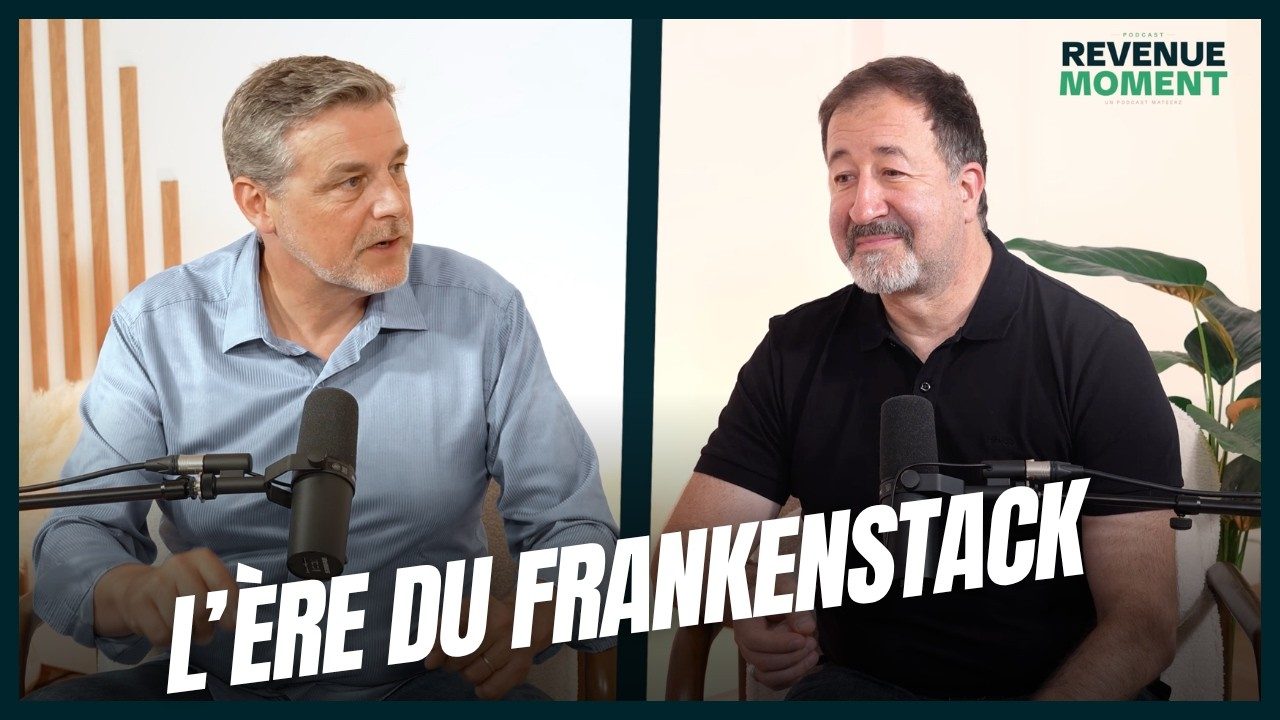
The conversation is in French, and the summary and article on this page are translated from French.
In this episode of Revenue Moment, Jean-François Thunet and Fabrice Buron, Senior VP Revenue Operations and Strategic Alliances at Outreach, unpack how AI is transforming the sales function. Their thesis is clear: the challenge is not to replace teams, but to increase their precision on every account. Given that more than 90% of information useful for sales efforts lives outside the CRM, sales leaders must regain control of signals, processes and data quality. The future of revenue depends less on stacking tools than on orchestrating them.
The central takeaway lies in the ability to turn a signal into a next best action. Fabrice Buron details the case of an executive change at a customer: detected too late, it weakens a relationship; captured in time, it triggers a personalized message and an introduction between leaders. This approach creates pipeline where teams saw only a blind spot. But AI does not correct imprecise execution: garbage in, garbage out. Listen to this discussion to understand how to structure a revenue machine that accelerates revenue without diluting commercial judgment.
What’s covered
- 00:00:00 Introduction and presentation of Fabrice Buron
- 00:03:13 Reinventing the sales function
- 00:07:13 Moving beyond the limits of the CRM
- 00:18:26 Prioritizing AI use cases
- 00:23:45 Capturing revenue signals
- 00:30:13 Improving sales precision
- 00:36:52 Transforming the role of the CSO
- 00:43:20 Measuring revenue impact
- 00:47:10 Preparing the agentic sales model
- 01:07:25 Summary and takeaways
A closer look: the Frankenstack era, tech that fragments sales
Jean-François Thunet speaks with Fabrice Buron, Senior VP Revenue Operations and Strategic Alliances at Outreach, about the transformation of sales. The guest describes a sales function augmented by AI, while warning about the Frankenstack: a set of tools and integrations built up over time that can complicate execution.
1. Introduction and presentation of Fabrice Buron
Fabrice Buron first led sales teams in Africa, in consumer retail and industry, across B2C and B2B activities. He then moved into technology, developed a consulting business and worked for several software vendors in the United States. At Outreach for the past year, he leads RevOps, the operations that connect processes, data and sales teams. He also uses the agentic products developed by his company for internal purposes.
2. Reinventing the sales function
2.1 From the manual sales cycle to digital
For Fabrice Buron, the principle of B2B sales has not changed: understanding a business problem, targeting the right customer and then building a credible response with them. Working conditions, on the other hand, have changed profoundly. He describes the early period of this change as highly manual.
From around 2010 to 2015, he estimates, digital marketing changed the relationship. Customers could access product information on their own. They no longer necessarily wanted to speak with a salesperson to discover a product, but rather when they began evaluating it. Salespeople therefore had to step in with more context and relevance.
2.2 AI as a force multiplier
AI first addresses a concrete constraint: Fabrice Buron can no longer cover enough accounts or enough activities with his teams. Call and meeting transcripts allow him to summarize conversations, better identify needs and spot the difficulties customers encounter.
This capability multiplies the work of both managers and salespeople. One person can analyze only a limited volume of information or support only one colleague at a time. AI extends this analytical capacity. It does not remove sales work: it provides more material to carry it out.
3. Moving beyond the limits of the CRM
3.1 90% of signals outside the CRM
Fabrice Buron estimates that more than 90% of the information useful for triggering a sales action sits outside the CRM. The CRM remains the system of record for contracts, orders and reporting, meaning performance tracking. But conversations, emails and external events often remain outside it.
AI tools can bring these sources together, produce summaries and analyze objections and disengagement signals. In the guest’s view, summarizing is not enough. The next step is helping teams act on that information when it becomes useful.
3.2 Reducing RevOps stack complexity
The stack refers to all the software used by an organization. Fabrice Buron observes that CRMs that have been used for a long time accumulate technical debt: past choices that make changes difficult. The stack itself becomes a monster that has grown organically. To cover certain needs, companies buy four or five specialized AI tools, then have to connect them to one another.
In organizations with 50 to 300 salespeople, RevOps teams can manage from 20 to 100 systems. Outreach uses 75. Fabrice Buron uses Claude for routine tasks, but does not recommend building every automation alone. An isolated analysis can happen quickly. Feeding its results back into sales processes and tools then requires substantial integration work.
4. Prioritizing AI use cases
4.1 Adding context to accounts and deals
A deal can be reviewed based on recent calls, objections and related activities. Salespeople, their managers or RevOps can then get a consolidated view without opening four or five applications. At Outreach, this review can also be used to inspect an opportunity before reassigning it or revising its forecast.
4.2 Making forecasting more objective
Forecasting is reviewed every week at Outreach. Opportunities are scored by AI based on observed events. A lack of follow-up, a lack of meetings with executives or expected actions left incomplete lower the score. The tool also explains the parameters behind this change.
Fabrice Buron sees this mechanism as far more objective than a forecast submitted by a salesperson who pushes back their close date for the third time and finds a reason to remain optimistic under pressure from their own sales target.
4.3 Defining the next best action
The next best action is the action to prioritize at a given point in time. Jean-François Thunet advocates more precise targeting without reducing prospecting volume. Fabrice Buron shares this approach. In his view, seeing AI as a way to reduce costs is the wrong angle.
AI’s role is to expand sales coverage while improving targeting and conversion. The tool can flag underused software, the departure of a contact or a proposal that has not received follow-up. It then helps the salesperson choose their next action.
5. Capturing revenue signals
5.1 Leadership changes and funding
Fabrice Buron cites a leadership change at a customer. His team did not always detect this signal. Automated, personalized emails based on LinkedIn profiles made it possible to start the conversation, then arrange meetings with Outreach sales leaders. The company was able to identify the opportunities resulting from this initiative and the additional revenue generated.
New hires, leadership changes and funding are among the signals most used by his team. An agent also reviews the financial disclosures of 4,000 accounts, surfaces identified themes, enriches missing contacts and then automatically creates personalized emails based on profiles.
5.2 Product usage and churn risks
Churn refers to a customer leaving or disengaging. At a software vendor, high usage can create an expansion or cross-sell opportunity. Conversely, low usage reveals an adoption issue. The team responsible for customer follow-up can then be brought in.
The absence of meetings between executives can also be a warning sign. Website visits and downloaded content provide other clues. Their value nevertheless depends on their context and on their combination with information already held about the account.
5.3 Detecting pipeline blind spots
The pipeline consists of opportunities already being tracked. Blind spots are different: they are pockets of business the company does not pursue because it does not see them due to a lack of human capacity. Fabrice Buron seeks to reveal them from scattered signals.
A signal indicating that a customer is interested in a competitor becomes more significant if it coincides with a leadership change and with calls in which that customer mentions evaluating other products. It is not the isolated signal that drives a decision. It is the correlation between several elements.
6. Improving sales precision
6.1 Personalizing without blindly automating
Fabrice Buron presents precision as AI’s other contribution, alongside revenue growth. Customers expect salespeople to prepare for conversations and bring more than they can find online. Yet the guest receives personalized messages seeking to sell him the type of system he sells himself.
The problem comes from overly generic automation and a poor starting signal. AI that is poorly implemented can therefore do more harm than good.
6.2 Coaching salespeople in real time
Content cards can assist a salesperson during a video conference. When an objection or question arises, they surface the relevant elements to use. Fabrice Buron compares this practice to a manager who would in the past feed a talking point to their salesperson, with the microphone muted.
6.3 Calibrating prompts and data
A prompt is an instruction given to AI. Fabrice Buron mentions an agent that reused the tagline from an unsuccessful marketing campaign to personalize messages. The system had found a well-written phrase, but one based on a campaign that had failed.
The prompt was therefore adjusted to also look for poorly received campaigns and exclude them. AI requires continuous calibration. The quality of data, rules and scenarios remains decisive.
7. Transforming the role of the CSO
7.1 Orchestrating data, processes and teams
According to Fabrice Buron, the CSO, or chief sales officer, must work with RevOps, even when the sales team has four or five people. The CSO must define their sales process and how their teams execute it. The guest has seen companies with 400 salespeople where each person independently built their information base and territory management method.
7.2 Moving from one-to-one to one-to-many coaching
One-to-one coaching is individual. One-to-many distributes the same guidance to several people at the same time. For Fabrice Buron, tools make it possible to move beyond the manager’s limitation of helping only one salesperson at a time.
He does not advocate total automation. The chief sales officer must explain to leadership what is needed, measure its effects and then secure the appropriate resources.
7.3 Structuring sales execution
The chief sales officer becomes more of a conductor, according to Fabrice Buron, “more Karajan than André Rieu.” He cites an internal study on tool usage and salesperson experience. The interviews were kept.
Their transcripts were run through Claude, which produced a sentiment and correlation analysis in one hour. The full process, previously conducted over four weeks to three months, was completed in one week. Teams were thus able to identify process and tooling improvements more quickly.
8. Measuring revenue impact
8.1 Pipeline created and influenced by agents
The main metric tracked by Fabrice Buron is pipeline created by AI agents: meetings secured, opportunities created and value added after a signal is identified. He also tracks pipeline influenced by agents.
8.2 Adoption of messaging and scorecards
When launching a platform, Outreach uses call transcripts to verify the themes salespeople actually present. Each week, a scorecard shows the share of calls covering the expected topics. The team can reinforce messages that are not sufficiently used.
8.3 Average deal size, velocity and productivity
Fabrice Buron tracks average deal size, conversion, the time between hiring a salesperson and their first sale, as well as velocity, meaning the time needed to close an opportunity. New tools capture more information from calendars, emails and calls, whereas the CRM gathers only part of the information generated across sales activities.
9. Preparing the agentic sales model
9.1 Managing costs and signal quality
Token-based billing models, in which tokens are units billed according to usage of AI systems, remain difficult to forecast. Fabrice Buron insists on three criteria: the cost of accessing signals, their quality and actual use of the tools. A high intent score does not always provide enough information to produce relevant personalization.
Some vendors also require customers to use the vendors’ own platform. This closed approach limits the flow of data. Transformation therefore does not happen automatically: the company must clarify its processes, define its needs and then assess the available tools.
9.2 Scaling teams without overhiring
Fabrice Buron gives the example of a company that raises a Series B, a funding round intended to accelerate its growth, and receives a target of 40% growth. Hiring does not have an immediate effect. It often takes six to twelve months before a new hire makes a real contribution.
Rather than hiring ten people and then discovering ten months later that the bet did not work, the company can consider a team of three or four people augmented by AI. The aim is not replacing teams with the tool, but reducing the upfront investment needed to accelerate.
9.3 The fractional CSO as an accelerator
Jean-François Thunet presents Mateerz’s fractional CSO service: an external chief sales officer works one to three days a week for three to six months. He asks Fabrice Buron for his view on this model.
The guest sees this arrangement as a shift expected to become established. The external expert provides outside reference points, supports implementation and oversees execution beyond one-off advice. A CEO or sales leader absorbed by day-to-day activity does not always have the necessary perspective.
10. Summary and takeaways
Fabrice Buron describes a sales function that is more precise, more structured and better equipped to reveal invisible opportunities. AI delivers value when it connects actionable signals to an action, then to a revenue measure. It replaces neither sales judgment nor calibration work. Its adoption also requires controlling stack complexity rather than amplifying it.