Revenue Moment
Orchestrating revenue in the agentic era
Cyril Simonnet, CRO at Sekoia
30 September 2026 · 58 min · Hosted by Nawfal Laghzali
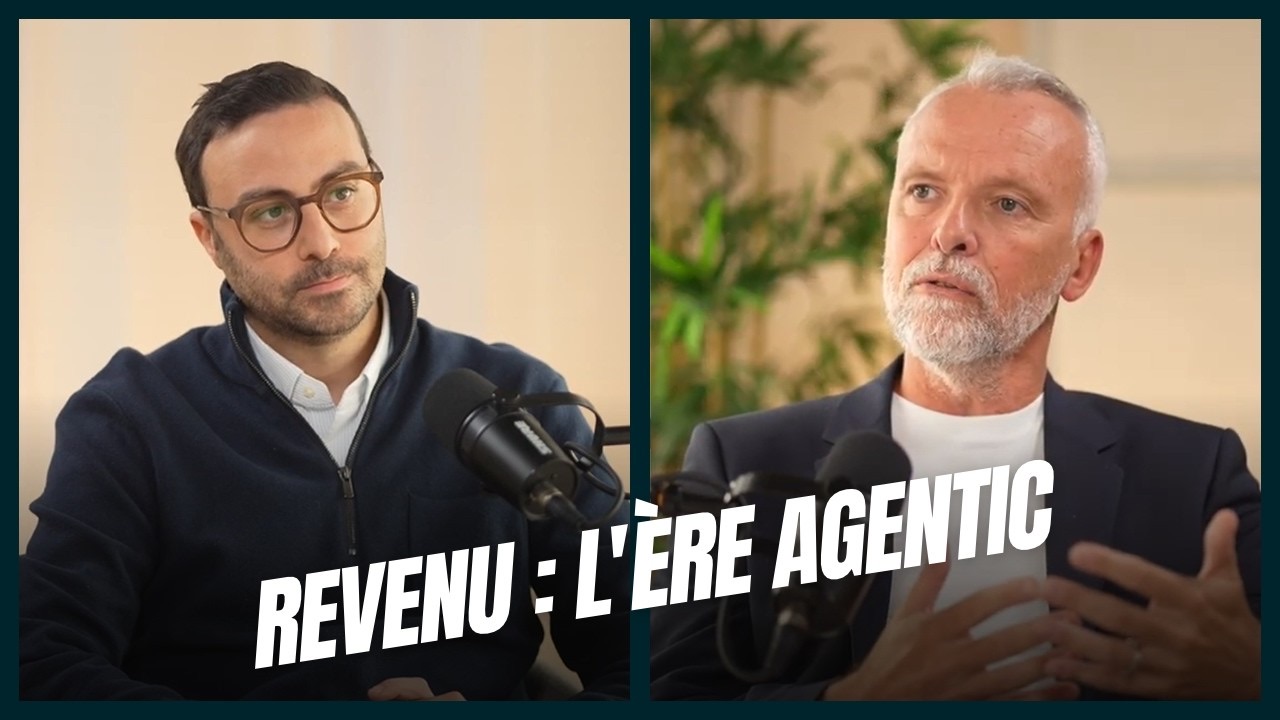
The conversation is in French, and the summary and article on this page are translated from French.
In this episode of Revenue Moment, Nawfal Laghzali and Cyril Simonnet, CRO of Sekoia, break down what AI is really changing in revenue leadership. The thesis is clear: leaders can no longer hide behind the big picture, nor can their teams hide in task execution. At the intersection of the overall view and on-the-ground granularity, the leader’s role becomes that of a coach able to continuously improve the system. For sales and revenue leaders, the challenge goes beyond productivity: building teams that use AI to better understand their customers, shorten their cycles and strengthen their impact.
The central takeaway: a high-performing playbook does not lock in answers: it turns accumulated context into more precise decisions. When pursuing his first deal in the United States, Cyril Simonnet submits his proposal to AI, asking it to identify his blind spots. He sends it only once, with no revisions, and gets a decision in three weeks. He then builds on a year of emails and transcripts to create an assistant able to cover 80 to 90% of recurring questions. Teams can then move beyond defensive responses to help their partners succeed. A useful listen for rethinking your growth engine.
What’s covered
- 00:00:00 Introduction to Cyril
- 00:03:00 Managing across macro and micro levels
- 00:11:18 Redefining your role with AI
- 00:18:17 Identifying blind spots
- 00:21:12 Building adaptive playbooks
- 00:30:01 Creating an operational second brain
- 00:39:14 Measuring the ROI of sales AI
- 00:43:02 Revealing zones of genius
- 00:53:54 Summary and the future of abundance
In detail: orchestrating revenue in the agentic era
1. Introduction to Cyril Simonnet
On Revenue Moment, Nawfal Laghzali, CEO of Mateerz, hosts Cyril Simonnet, CRO of Sekoia since February 2024. This French cybersecurity software company, whose development work is carried out in Brittany, provides tools and services to security operations centers, or SOCs, as well as to the partners that deliver these services to their clients. Its mission is to accelerate the transition from detecting an attack to responding to it. Before Sekoia, Cyril Simonnet worked at Symantec, Qualys, Varonis and Palo Alto Networks.
2. Managing across macro and micro levels
His approach starts with process. For Cyril, the challenge is to make an entire process work without losing sight of the specific elements that determine its performance.
2.1 Process, Kaizen and continuous improvement
With an engineering background, Cyril aims to control a complete process with an identifiable probability of success. He cites 60% as a level that is already satisfactory. His metaphor is a windshield wiper: a constant movement between the big picture and the details that can be corrected.
He compares this practice with Kaizen and Six Sigma. Progress comes from an accumulation of small corrections rather than a single change. When certain phases become more reliable, steps can be shortened or removed. Sales nonetheless remains shaped by human uncertainty, which makes a perfectly tuned machine impossible.
2.2 Getting out of the ivory tower
Why do some leaders stay at the macro level? Cyril offers an explanation: their superiors primarily expect metrics and oversight from them. In a large company, a leader can delegate execution to a trusted team. In a startup or scale-up, limited resources make direct involvement more necessary.
He says he has seen CEOs of groups with 30,000 to more than 100,000 employees personally go to the front line, sometimes more effectively than he does. If leaders at the top do not settle into an ivory tower, others have no reason to do so. Nawfal Laghzali sees this as the effect of crises and AI: the playbook is now built in the field.
3. Redefining your role with AI
At Sekoia, according to Cyril, the debate has moved beyond the question of AI’s general usefulness. Teams are asking to use it. The discussion now focuses on use cases.
3.1 Moving from effort to outcomes
He gives the extreme example of a task that could go from one day to five minutes, while acknowledging that he is exaggerating the timelines. Such situations do exist. The eight hours recovered can become a void for someone who does not know what to do with them, and the manager cannot redefine this new work on their behalf.
This shift requires leaving behind a culture of effort to focus on the outcome. Cyril sees salespeople so absorbed by the energy invested in an opportunity that they forget their objective. AI then refocuses the issue on what is actually achieved rather than on the intensity of the work performed.
3.2 Becoming human on the loop
Cyril believes that many people remain human in the loop, meaning that they check every AI output. In his view, this need to retain control also reflects a concern with managing their personal risks and employability, along with a survival instinct. He favors working as human on the loop, where people manage a process that moves faster thanks to agentic AI.
Nawfal Laghzali observes that people become the bottleneck when this transition has not taken place. For Cyril, what makes a person indispensable is not the task they perform but the growth they drive. He cites radiologists: AI does not make them disappear, it increases the need for practitioners because there are more examinations and their role is changing.
4. Identifying blind spots
Cyril compares blind spots to the area a rearview mirror does not show.
4.1 Testing a proposal with AI
At Sekoia, for his first sale in the United States, Cyril is less familiar with that market than with Europe. The prospect deliberately remains vague about its need. Cyril Simonnet has no one to review his response. He therefore asks AI to act as the prospect issuing the request, with a specific role and need, then identify the blind spots in his proposal.
He adds to his document based on this list, sends it once and does not revise it. A decision comes three weeks later, but the episode does not specify the outcome.
4.2 Turning lessons into a template
This proposal then becomes, in his view, almost a template.
5. Building adaptive playbooks
Nawfal Laghzali stresses that the advantage goes to companies that accumulate their context, structure it and make it accessible.
5.1 Structuring questions and decision makers
A playbook organizes stages, with progression through each one depending on questions. Cyril specifies that salespeople must ask them of themselves as well as of all stakeholders. On the customer side, the questions must cover influencers and the different roles, whose objectives may conflict.
Internally, finance, legal, product and management do not have the same priorities as the sales team. He cites MEDDPICC among the methods that make it possible to cover these dimensions, provided it is adapted to the use case.
5.2 Accelerating partner sales
Sekoia equips partners that use its tools and services to deliver a security service to their own customers. Cyril compares this role to that of a Michelin tire on a Renault: the tire is essential to the vehicle without being the main reason for buying it. These partners sell a service capable of detecting an attack, investigating it and responding to it in under two minutes.
He believes that this promise was still a luxury one year earlier and has become indispensable since summer 2026. Swarm attacks by agents are not more intelligent, he says, but they are numerous and powerful. He compares them to a fire starting in 30 factories at once. In his view, NIS 2 and DORA also require this responsiveness, particularly in critical infrastructure.
After gathering one year of emails and meeting transcripts, he describes an assistant that answers, by his estimate, 80 to 90% of questions. The salesperson can then help the partner sell its own service instead of handling every request. In his scenario of 40 partners, the 41st would almost buy the approach rather than the product. AI helps prepare it, even if it does not yet work directly with the potential partner.
6. Creating an operational second brain
For Cyril, everyone needs a second brain: a personal system that stores information and retrieves it with the necessary context.
6.1 Capturing and structuring context
He recommends a structured wiki rather than a vector database. He favors local storage because of his cybersecurity instincts, comparing this personal data to a DNA sample he would not want to share without safeguards. The aim is to be able to prepare an email while taking into account an old decision that human memory has forgotten.
The first pillar is this documentation structure. The second is the continuous capture of prompts, outputs, emails, transcribed meetings and reading material, using Python scripts. He points out that consent must be obtained before recording a conversation. In regulated sectors, transcription can also remain local.
Skills, or modules set up within the AI assistant, then retrieve the relevant context before responding. They evolve with use. The tools may change, but Cyril retains these foundations: structured memory, organized data capture and assistants able to use the context.
6.2 Automating daily priorities
Every morning at 7 a.m., Cyril receives an email that prioritizes his day based on his calendar, messages received over the previous two days and his recent meetings. A Python script, automatically run by a cron job at a set time, ranks topics by urgency and importance, then estimates the time to devote to them.
The system could block time slots in his calendar, but Cyril leaves this feature inactive because he prefers to retain that freedom. The system also prepares drafts: Cyril says he sends only one in five, while finding it useful to be able to quickly handle certain messages buried in the daily flow.
7. Measuring the ROI of sales AI
Nawfal Laghzali raises the question of return on investment: can it be quantified when some companies do not immediately see the gain quarter after quarter? Cyril replies that he does see a return.
7.1 Shortening sales cycles
His argument rests on processing speed. AI makes it possible to handle more matters in parallel and avoid delays in the sales process. By his estimate, it can save one or two months on a sale.
He also stresses the precision of responses. When the salesperson already has the context and anticipates the next question, they can respond to a need before the customer has even expressed it.
7.2 Hiring augmented talent
So far, Cyril does not see AI as a way to hire fewer people. The faster pace of business may instead lead to expanding teams. His challenge is finding people who understand how to become human on the loop in their own profession.
They are his A players: he wants them to augment him, make him better and surpass him. He describes a process of personal acceptance that each person moves through more or less quickly. He compares this transition to moving from the typewriter to Word.
8. Revealing zones of genius
Cyril is convinced that AI brings people to the forefront. It handles the routine part of work, while differences between people gain value in a world saturated with standardized messages.
8.1 Making the most of individual strengths
No one can define their own zone of genius alone, in his view. It is often revealed when a colleague is surprised by an ability the person experiences as natural. Passionate people draw energy from it that pushes them to explore, seek lateral paths and go further.
He predicts that by 2028, pyramid-shaped organizations, where process or the playbook takes precedence over people, will have become obsolete. He is talking about companies where he has worked, not Sekoia. An organization that stifles these distinctive talents risks losing them to other employers. Finding the complementary colleague remains difficult in a small team, but AI, automation or a service provider can cover certain weaknesses.
8.2 Managing like a coach
He compares the manager to a coach who adapts the game plan to the players’ strengths. The manager’s role is to identify these strengths, help people progress and place them where they can create concrete impact every day, rather than letting them spend their time on what they do poorly.
He tells the story of a technician who repairs automated machines and develops a barcode application in the evenings and on weekends to improve the company’s operations. After presenting it, the technician becomes the hero of the organization. Cyril believes this employee’s manager may have missed the opportunity to build on it by not repositioning him in a role that would allow him to keep improving how the company works. Team cohesion, listening and mutual support between colleagues remain qualities agents do not possess.
9. Summary and the future of abundance
Cyril does not claim to know what will happen. He points out that it will not necessarily go well for everyone and that he himself could suffer the consequences. Yet he wants to play the game. He thinks back to a book by Jacques Attali that he read about 20 years ago, whose title he cannot remember, about the division of the world between local and global.
9.1 Reconciling local and global
In his description, the local world rests on human relationships, mutual aid and skills exchanged at a nearby scale. He says he observes this logic among entrepreneurs and residents.
The global world is driven by speed, performance, efficiency and quick gains. He associates it with the world of finance while believing it will extend to more sectors.
9.2 Putting people back at the center
Robotics could reinforce this global world by creating a faster and broader dynamic of abundance. Cyril already sees signs of it in information, TV series and music. He hopes this abundance will also reach food and healthcare.
10. Summary and takeaways
Revenue leadership requires a constant back-and-forth between the entire process and its details. Metrics do not exempt leaders from understanding execution, especially when playbooks are built through action.
AI becomes useful when it makes context available, reveals blind spots and shortens response times without sacrificing the precision of responses. The time freed up must be reinvested in redefining work and pursuing outcomes.
The manager’s role is to identify zones of genius, cover certain weaknesses through organization or tools and place each person in a situation where they can aim for concrete impact during their day.